Andreas Grün✕
| Home | Repertoire | Contact |
Raphael Dressler
c. 1784 – 1835
Duos for Flute and Guitar
Raphael Dressler was born in Graz around 1784. In 1809 he joined the orchestra of Vienna's
Kärntnertortheater as first flute. In 1817 he moved to the Königliche Hofkapelle in
Hanover in the same position. From 1820 until 1834 he worked in England, before dying in
Mainz on 12 February 1835.
During his lifetime Dressler was a flautist of such renown that his New and Complete
Instructions for the Flute, op. 68 was published almost simultaneously by several
publishers in London, Bonn, and New York in
His output — around one hundred works, of which roughly seventy were published
during his lifetime — consists chiefly of chamber music and solo works, alongside
three concertos for flute and orchestra: études and variations for solo flute, flute duos and
trios, and several works for flute with strings or piano.
During his final years in Vienna in particular, he composed a number of duos for flute and guitar.
Unfortunately, it is not known for which guitarist these works were written. Although he dedicated
his Six Thèmes variés, op. 43 “à son ami Theodor Gaude” (just as the guitarist
Theodor Gaude, in turn, dedicated his Sonata
for flute and guitar, op. 24 to Dressler), the two probably did not become acquainted until
after 1817. While the guitar parts in most of these duos are generally kept quite simple,
they occasionally contain passages of such technical difficulty and such an idiomatic command
of the instrument that one is tempted to assume that between 1815 and 1817 Dressler had been in
contact with one of Vienna’s leading guitarists.
This applies above all to his Variations sur la Romance de l’Opera « Joseph et ses
freres de Mehul », op. 28, probably published in 1816, which must rank
among the finest works written for this combination. Joseph, premiered in Paris in 1807,
was the most successful opera by Étienne-Nicolas Méhul (1763–1817). Its combination of a biblical
subject with exotic local colour appealed strongly to contemporary audiences and earned it particular
acclaim in Germany. In Vienna the work was presented at the Theater an der Wien in 1809 under the
title Joseph in Ägypten, and at the Kärntnertortheater in 1815 as Joseph und seine
Brüder. It is reasonable to assume that Dressler became acquainted with the opera through his
position as first flute at the Kärntnertortheater and composed his variations on the romance
A peine au sortir de l’enfance while the performances were still fresh in his mind.
Joseph’s account of his abduction by his brothers forms one of the opera’s lyrical high points, a scene
that Méhul evidently crafted with particular care. The fact that Dressler refers to it simply as la
Romance in his title suggests that he assumed it to be widely known. Accordingly, even in his presentation
of the theme he allows himself a few — albeit slight — liberties, making the melody
more fluid and expressive where Méhul’s original follows the natural inflections of the French language.
With his Variations sur un Theme hongré [sic!], op. 25, published in 1815,
Dressler followed the growing fascination with Hungarian music that had emerged around 1790 and
also left its mark on the music of composers such as Haydn, Beethoven, and Schubert. His theme is
a typical verbunkos, a type of dance music originally used for military recruiting. By the time
Dressler was living in Vienna, however, the verbunkos had long since outgrown this original function
and had become an immensely popular musical genre in the Danube metropolis. During the years of the
Congress of Vienna (late September 1814 to early June 1815), when the city — with its
countless visitors — had effectively become the capital of Europe, musicians from every
corner of the Habsburg monarchy earned their living in an enormous programme of concerts, masked balls,
festivities, tavern entertainment, and salon music. Interest in Hungarian music was further stimulated
by this unique cultural climate, and a number of Hungarian melodies achieved great popularity.
Dressler's theme also appears in at least two other collections of guitar music: towards the end of
1816 in Mauro Giuliani's La Lira Notturna, op. 69, for two guitars, and in early 1820 in
Anton Diabelli's Apollo am Damentoilette for solo guitar, an album of arrangements of popular
melodies by Mozart, Beethoven, Rossini, Grétry, and others — which also includes Méhul's
romance.
Whereas Dressler refers only to a “Hungarian theme”, Diabelli entitled his arrangement five years later
Hongrois von Pechatschek. Indeed, a Czech library preserves a manuscript violin part containing
variations on the same theme, attributed to “Francois Pechatschek”: Variations pour le Violon sur un
thema Hongreois avec l'accompagnement de deux Violons, Alto, Violoncello. Whether “Francois” refers
to the father, Franz Martin (1763–1816), or to his son Franz Xaver (1793–1840) Pecháček cannot be
determined with certainty, although the latter seems more likely, having served as a violinist at the
Theater an der Wien from 1809 to 1822 while also enjoying an outstanding career as a soloist. Unfortunately,
the manuscript is undated, leaving a second question unanswered: were these variations composed before
Dressler's, or afterwards? And there is a third unresolved question: was the theme itself — quite
apart from the variations — an original composition by one of the two Franz Pecháčeks “à la
Hongroise”, or, more probably, was it based on an authentic Hungarian verbunkos?
Since identifying a well-known theme was an established and commercially advantageous practice, and since
Dressler followed this practice elsewhere as well — as in his variations on Méhul's romance,
or those “über ein Thema aus dem Ballet Nina” and “sur un thême favori de l'Opera Jean de Paris”, also for
flute and guitar — it seems likely that the theme only became associated with the name Pecháček
sometime between 1816 and 1819 through the brilliant variations of the young virtuoso Franz Xaver, whereas
for Dressler it was still simply an anonymous “thème hongrois”.
Andreas Grün
I am grateful to Gerhard Penn for drawing my attention to the fact that Dressler's theme was also published by Diabelli, bearing the attribution “von Pechatschek”. Many thanks for this valuable information!
 Variations sur un thème hongrois, op. 25
Variations sur la Romance de l'opéra « Joseph et ses frères » de Méhul, op. 28
Music editions (first modern publications)
Variations on a Romance by Méhul
for Flute and Guitar, ed. by Frank Michael / Andreas Grün, Musikverlag Zimmermann, ZM 33330
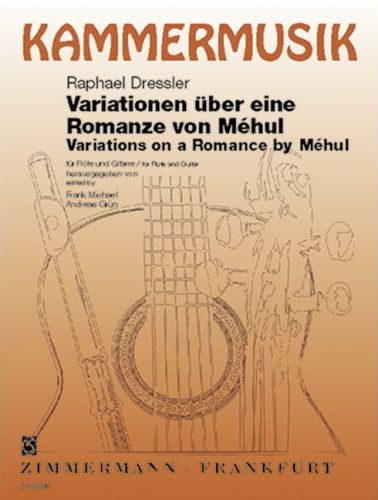
 buy sheet music (www.schott-music.com)
Variations on a Hungarian Theme
for Flute and Guitar, ed. by Frank Michael / Andreas Grün, Musikverlag Zimmermann, ZM 34700
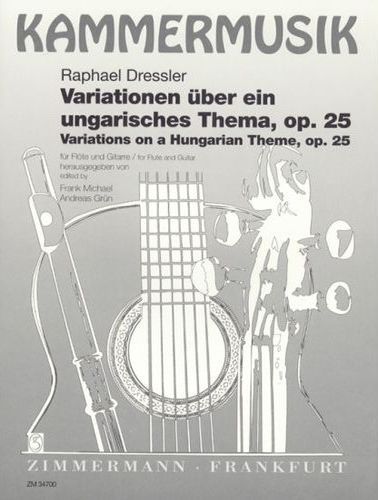
buy sheet music (www.schott-music.com)
Press comments
This late Classical work is certainly one of the most successful sets of
variations for these two instruments, from a prolific period for this form.
The flute part, while being very virtuosic in places, retains the lyrical style of the
original aria from the Méhul opera, and the guitar part has considerable melodic and
rhythmic interest. It is a valuable addition to the repertoire for two instrumentalists
of Grade 8+.
Pan Magazine
Outre l’avantage de sortir des sentiers battus en exhumant une œuvre et un auteur inconnus, cette partition devrait intéresser tous les instrumentistes désireux de mettre en valeur le caractère brillant de la flûte.
Traversières Magazine
Colpito dalla romanza di Giuseppe A peine au sortir de l’enfance gli dedicò questo lavoro cameristico molto interessante.
Syrinx
Eine gute Repertoireergänzung für Duos!.
Concertino
Heinrich Aloys Präger, Theodor Gaude und Raphael Dressler haben Musik hinterlassen, die zu vergessen, schlicht eine Schande wäre.
Die Rheinpfalz